Romantic Happy Propose Day Calligraphy
First Impressions: Grace, Not Gimmick
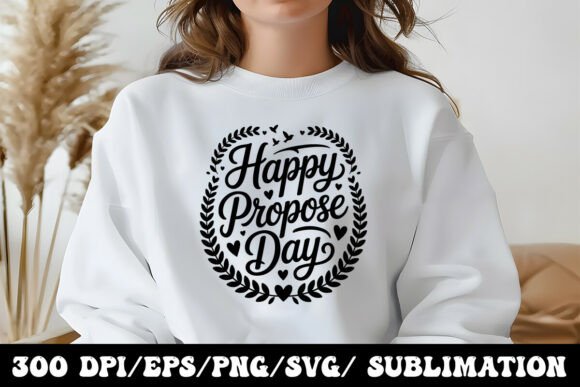
When I opened Romantic Happy Propose Day Calligraphy, I didn’t see another Valentine’s trope—I saw a quiet confidence in its composition. The calligraphy flows like ink on parchment, not like a stock graphic slapped onto a template. The flying birds aren’t cartoonish; they’re subtle, upward-leaning silhouettes that suggest movement without clutter. And the floral wreath? It wraps the phrase with soft asymmetry—no rigid symmetry here, just organic balance. This isn’t a design shouting “love!” It’s whispering it. That makes all the difference when you’re stitching it onto something meant to be held, gifted, or worn.
A Real Project Test: Embroidering a Linen Tote for a Boutique Launch
Last week, I prepped Romantic Happy Propose Day Calligraphy for a limited-run linen tote bag—part of a small shop’s Propose Day collection. Linen’s slubby texture demands clarity, not complexity. So I asked myself: Does this design breathe on fabric? Yes—but only if treated right. The letterforms have generous spacing and open counters (like the ‘a’, ‘e’, and ‘o’), which prevents fill stitch bleeding at medium density. The birds sit cleanly above the baseline, avoiding awkward vertical compression. And the wreath’s petals are spaced far enough apart to avoid thread nesting in tight corners. On the tote, it landed exactly as intended: elegant, legible, and quietly meaningful—not overly sweet, not too formal.
Where It Shines—and Where It Asks for Care
Romantic Happy Propose Day Calligraphy excels on stable, medium-weight fabrics: cotton twill aprons, midweight sweatshirts, canvas pillow covers, and structured tea towels. It reads beautifully at 4–5 inches wide—ideal for chest embroidery on crewnecks or centered placement on tote fronts. As a machine embroidery design, it holds up well in satin-stitched lettering and delicate fill-stitched florals, assuming moderate stitch density. It also translates smoothly into a printable mockup for Etsy sellers previewing digital embroidery files.
But don’t rush it onto stretchy knits or thin baby onesies without testing. The fine lines in the calligraphy—especially the tapered ends of letters like ‘y’ and ‘g’—can vanish on jersey or low-thread-count cotton unless stabilized properly. On dark fabric, contrast matters: light thread (ecru, blush, or soft grey) reads better than stark white, which can look harsh against charcoal or navy. And avoid placing it near curved seams or cap bills—the wreath’s outermost leaves may distort if hooped too tightly on uneven surfaces.
What It Adds to Your Handmade Product (and What It Doesn’t)
This isn’t a “filler” graphics file. It carries intention. When stitched onto a handmade pillow cover or embroidered patch for a proposal picnic basket, Romantic Happy Propose Day Calligraphy elevates perceived value—not because it’s flashy, but because it feels considered. Customers notice that. They trust a product where the design supports the sentiment instead of shouting over it. For craft business owners, that builds brand consistency across holiday embroidery collections. For Etsy sellers, it improves buyer engagement: people pause, read, smile—then click “add to cart.”
That said, it won’t carry weak execution. If your stitch density is too high, the birds blur into smudges. If you skip proper cutaway stabilizer on knits, the calligraphy warps. And if you use mismatched thread colors—say, neon pink on ivory linen—it breaks the mood entirely. This design rewards attention to detail, not speed.
Practical Notes Every Embroidery Designer Should Check
- Test first on scrap fabric matching your final product’s weight and stretch.
- Review stitch density—especially in the wreath’s inner loops and bird wings. Overly dense fills trap lint and stiffen fabric.
- Confirm hoop size compatibility. The full layout likely needs at least a 5×7 inch hoop for clean registration.
- Inspect tiny details in black-and-white mockups—some subtlety disappears without color context.
- Compare how it reads on both light and dark backgrounds before finalizing thread colors.
- Use appropriate stabilizer: cutaway for knits, tear-away for stable wovens, and lightweight fusible for delicate linens.
- Verify licensing terms before selling finished items or bundling the digital embroidery file with other design assets.
Fit for More Than Just T-Shirt Designs
Though listed under T-Shirt Designs, Romantic Happy Propose Day Calligraphy is far more versatile. I’ve seen it work as a standalone embroidered patch sewn onto denim jackets, scaled down for baby onesie collars (with simplified bird outlines), and even adapted as an applique design for nursery wall hangings. Its rhythm suits custom apparel, yes—but it also fits boutique branding: think embroidered gift tags, monogrammed proposal boxes, or stitched labels on handmade chocolates. It’s equally at home in holiday embroidery collections and wedding gift suites, especially for couples who prefer poetry over punctuation.
Final Thought: A Design That Earns Its Place
In a market flooded with generic love motifs, Romantic Happy Propose Day Calligraphy stands out by trusting the viewer—and the maker—to feel its nuance. It doesn’t need glitter or hearts to signal romance. It earns its place through proportion, restraint, and thoughtful spacing. Use it where sincerity matters: on gifts that will be kept, on products that represent care, and in craft businesses where every stitch reflects intention. Just remember—this design doesn’t hide flaws. It highlights them. So test it, respect its structure, and let it do what it does best: speak softly, clearly, and memorably.